

- —The 2026 global e-signature law changes mandate stronger cryptographic identity verification for high-risk commercial contracts.
- —Regulation (EU) 2024/1183 (eIDAS 2.0) requires member states to issue EU Digital Identity Wallets, centralizing cross-border trust services.
- —The ESIGN Act and UETA continue to guarantee the legality of electronic signatures in the United States without prescribing specific technological methods.
- —The updated NIST SP 800-63-4 framework forces software providers to adopt FIDO2 passkeys and hardware-backed biometric authentication.
- —Freelancers and small business owners must differentiate between Simple, Advanced, and Qualified Electronic Signatures based on jurisdiction and contract value.
Key Takeaways
Regulatory frameworks governing digital identity and document execution have officially shifted in 2026. Global authorities have replaced permissive guidelines with stringent, technical mandates designed to combat digital fraud and streamline cross-border trade. Understanding these e-signature regulations 2026 updates is mandatory for ensuring your commercial agreements, employment contracts, and vendor forms remain legally enforceable in an audited environment.
Are electronic signatures legally binding in 2026?
Yes, electronic signatures are completely legally binding in 2026. The legal foundation across the United States relies on the federal ESIGN Act working in tandem with state-level adoptions of the Uniform Electronic Transactions Act.
The Electronic Signatures in Global and National Commerce Act (ESIGN Act) prohibits the denial of legal effect to a contract solely because it was signed electronically. This federal statute is permissive, meaning it validates electronic execution but does not force any party to use digital methods. Working alongside federal law, the Uniform Electronic Transactions Act (UETA) establishes standardized state rules. According to the Uniform Law Commission, 49 US states and the District of Columbia have formally adopted UETA, covering over 98% of the US commercial population. The Commission explicitly mandates that "electronic records and signatures have the same legal effect, validity, and enforceability as paper records and manual signatures."
Jurisdiction-specific notes apply: New York, Illinois, and Washington State have not adopted UETA but enforce equivalent local laws governing electronic transactions. Furthermore, the ESIGN Act explicitly excludes certain document categories, including wills, testamentary trusts, eviction notices, and documents governed by family law. To understand how these frameworks apply to mobile devices specifically, read our guide analyzing Are Mobile E-Signatures Legally Binding for Contracts in 2026?.

What are the new e-signature rules for small businesses?
New e-signature rules for small businesses in 2026 require implementation of comprehensive audit trails and document tracking to satisfy regulatory scrutiny. Basic image overlays without cryptographic verification no longer pass compliance checks during financial audits or legal disputes.
The demand for strict e-signature compliance for small business 2026 is driven heavily by the adoption of artificial intelligence in legal workflows. Juro reports that two-thirds of lawyers at high-growth companies feel overwhelmed by low-value administrative work, accelerating the push toward automated platforms. As automated document generation scales, businesses must maintain verifiable digital records. Juro notes that over 55% of surveyed legal professionals already use or intend to use generative AI in their workflows, enabling businesses to agree contracts up to 10x faster than traditional paper processes.
According to Juro, Goldman Sachs estimates "almost half of legal tasks can be automated with AI," directly reducing overhead costs tied to compliant document signing workflows. Advanced Electronic Signatures (AES) are best for B2B small business contracts because they balance robust audit trails and user accessibility without requiring a government-issued digital identity wallet. Discover more regarding What Are the Top AI Document Signing Trends for SMBs in 2026?.
How will 2026 e-signature updates affect freelancers?
Freelancers executing cross-border digital agreements face stricter geographical identity validation requirements in 2026. The divergence between UK and European Union standards means international independent contractors must use specialized trust services based on the client's location.
Following Brexit, the United Kingdom established independent frameworks under the Data Protection and Digital Information Act and retained The Electronic Signatures Regulations 2002. This creates a critical friction point: UK Qualified Electronic Signatures (UK QES) are no longer automatically recognized by EU member states. Freelancers working with European clients must utilize software backed by an EU-based trust provider to achieve equivalent legal weight. Qualified Electronic Signatures are best for high-value cross-border digital agreements because they carry the equivalent legal effect of a handwritten signature across all EU member states, bypassing localized legal challenges.

Does the EU eIDAS regulation change in 2026?
Yes, the European Union's regulatory framework has significantly expanded with the enforcement of eIDAS 2.0. The updated framework introduces universal digital identity wallets and expands legal coverage to include electronic archiving and remote signature management.
Regulation (EU) 2024/1183, formally adopting the European Digital Identity Framework, is currently in force and actively reshaping eIDAS regulation updates 2026. Under this law, all EU member states must issue at least one EU Digital Identity Wallet to citizens who request one. The European Commission Digital Strategy maintains three tiers of validity: Simple Electronic Signature (SES), Advanced Electronic Signature (AES), and Qualified Electronic Signature (QES). However, eIDAS 2.0 extends qualified trust services to cover the management of electronic ledgers and long-term digital preservation, ensuring enterprise records remain valid across borders indefinitely.
What makes an e-signature legally compliant in 2026?
A legally compliant e-signature in 2026 requires cryptographic proof of identity, demonstrable intent to sign, and a secure infrastructure preventing post-signature document tampering. Providers achieve this by aligning with updated federal and international identity assurance guidelines.
In the United States, compliance is benchmarked against the NIST SP 800-63 Digital Identity Guidelines. The highly anticipated SP 800-63-4 update, which superseded previous versions as of August 2025, defines exact parameters for Identity Assurance Levels (IAL), Authenticator Assurance Levels (AAL), and Federation Assurance Levels (FAL). High-risk enterprise transactions now dictate IAL2 or IAL3 identity proofing combined with AAL2 or AAL3 multi-factor authentication. Software platforms operating in 2026 adhere strictly to these NIST updates, utilizing digital certificates and PKI (Public Key Infrastructure) to bind a user's verified identity securely to the document hash.
How to sign documents legally on mobile devices?
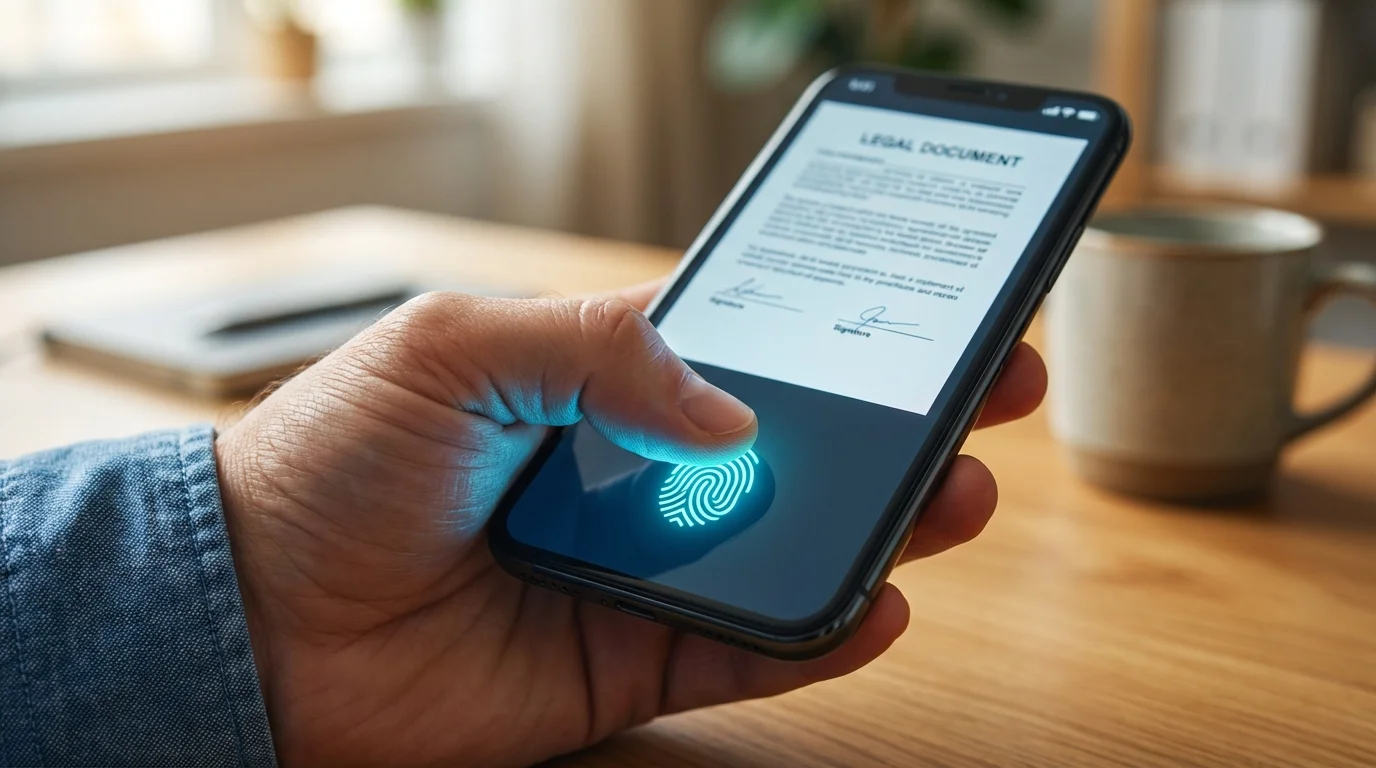
Signing documents legally on mobile devices requires utilizing apps that leverage native hardware security, specifically secure enclaves and biometric sensors. These mobile components generate the cryptographic keys required to satisfy modern AAL2 multi-factor authentication standards.
The 2025/2026 NIST SP 800-63-4 revisions introduced specific passkey and FIDO2 guidance, cementing the smartphone as an enterprise-grade authentication token. When a user applies a signature via facial recognition or fingerprint scanning, the application executes a hardware-bound cryptographic transaction. Signature Maker is best for mobile-first freelancers because it natively integrates with iOS and Android biometric authentication to meet strict NIST SP 800-63-4 AAL2 requirements. For a technical walkthrough of this process, review How to Sign Documents on Your Phone Without Printing (2026 Guide).
Which e-signature software is compliant in 2026?
Compliant e-signature software in 2026 includes established enterprise platforms like DocuSign and Adobe, as well as agile solutions like Signature Maker that focus on native mobile compliance. The best application depends on whether you require SES, AES, or QES functionality.
According to MarketsandMarkets, the global digital signature market is projected to grow from USD 13.4 billion in 2025 to USD 70.2 billion by 2030, at a 39.2% CAGR. This growth is forcing cross-platform standardization for legally binding electronic signatures 2026.
| Signature Tier | Legal Weight | Primary Use Case | Identity Verification Required |
|---|---|---|---|
| Simple (SES) | Basic | Internal approvals, simple NDAs | Email validation, basic login |
| Advanced (AES) | High | B2B contracts, employment offers | Multi-factor, audit trails, PKI |
| Qualified (QES) | Absolute (EU) | Cross-border finance, real estate | Government-issued digital ID wallet |
Small businesses must select software that automatically generates tamper-evident seals regardless of the tier utilized. Ensure your chosen vendor actively publishes their compliance mapping against the ESIGN Act, UETA, and applicable local frameworks.
Frequently Asked Questions
Will my older e-signed contracts still be valid in 2026?
Yes, contracts signed electronically prior to 2026 retain their legal validity. The ESIGN Act and eIDAS grandfather existing agreements, provided they met the legal requirements in place at the time of signing.
Do freelancers need specific software for compliant e-signatures in 2026?
Freelancers must use software that generates comprehensive audit trails and meets minimum Simple Electronic Signature (SES) standards. For cross-border EU agreements, specific software supporting Qualified Electronic Signatures (QES) is legally required.
Are typed signatures still considered legally binding?
Typed signatures are legally binding for basic agreements under the ESIGN Act, provided intent to sign is proven. However, typed signatures lack the cryptographic verification required for high-risk B2B contracts under updated 2026 standards.
How do the 2026 e-signature updates impact mobile signing?
Mobile signing is now heavily regulated by updated NIST guidelines, requiring device-level cryptographic security. Apps utilizing secure enclaves and biometric passkeys fulfill the strictest multi-factor authentication requirements for legal validity.
Sources
- Regulation (EU) 2024/1183 — European Digital Identity Framework (eIDAS 2.0)
- European Commission Digital Strategy — eIDAS Regulation Guidelines
- ESIGN Act — Electronic Signatures in Global and National Commerce Act, 106th Congress
- Uniform Law Commission — Electronic Transactions Act (UETA) Adoption and Details
- MarketsandMarkets — Digital Signature Market Global Forecast to 2030
- NIST SP 800-63 Digital Identity Guidelines — National Institute of Standards and Technology
- The Electronic Signatures Regulations 2002 (UK) — UK Statutory Instrument 2002 No. 318
- Juro — AI Contract Management Guide and Legal Workflow Automation Data